
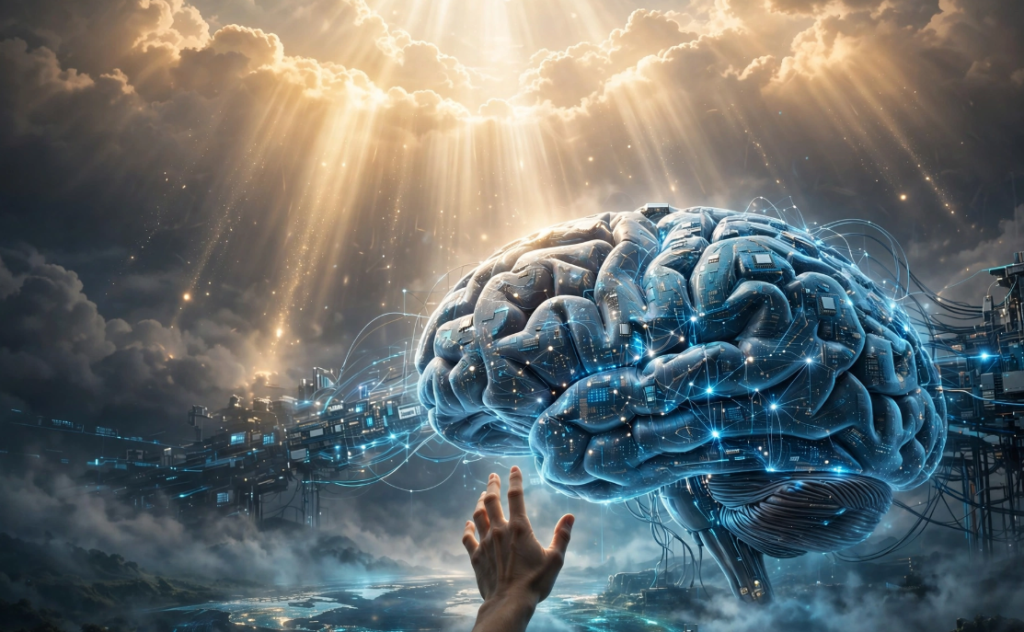
The conversation around Artificial Intelligence has shifted remarkably in recent times. It is no longer “Can AI do this?” It is now “Should AI be allowed to do this?” From Silicon Valley to Geneva, scientists, philosophers and even the very men who built AI are calling for a pause.
Why the Call to Slow Down?
The debate is not about ChatGPT writing good or bad essays. It is about three real fears that have moved from science fiction to boardroom and top government briefings.
First, there is an existential fear. In 2023, an open letter signed by Elon Musk, Steve Wozniak and over 1,000 AI researchers called for a six-month pause on training systems more powerful than GPT-4. Their argument was blunt: we are building systems no one, including their creators, fully understands.
Geoffrey Hinton, the Nobel Prize winner known as the “Godfather of AI”, resigned from Google to warn that AI could soon outsmart its makers. Not because AI hates us, but because a superintelligence pursuing a goal we gave it could see humans as an obstacle. It is not malice. It is logic without conscience.
Truth, Work and War
Second is the societal fear. AI-generated images have not only swayed elections but pose increasing dangers to electoral processes across the world; voice clones have defrauded families, and autonomous weapons are no longer theory.
The U.S. Department of Defence, the EU, and the Vatican have all held separate summits on the same question: How do you regulate a technology that learns faster than lawmakers can legislate?
The Nigerian reality makes it more urgent. In a country where over 100 million people are online, a single deep fake video on WhatsApp can trigger regrettable actions before it is debunked. When jobs are already scarce, what happens when AI replaces call centres, entry-level coding, graphic design, journalism, and many others?
Redefining What it Means to be Human
There is the spiritual concern. AI can now write sermons, pray like a pastor, and counsel like a therapist. It can mimic worship and empathy without ever feeling it. The danger here is subtle. If a machine can do everything a human can do, do humans still have unique value?
This has drawn ethical campaigners and religious bodies into the AI safety debate. The technology itself is asking a theological question: Are we creators, or are we now playing Creator?
The Kingdom Perspective
This must be stated clearly: God is not and will never be anxious. For the Christian, this debate can breed fear. Headlines scream “AI will take over the world.” But Scripture gives us a different anchor for history.
No doubt, the call to slow down AI is necessary, wise and responsible. Daniel 12:4 states that at the time of the end “…many shall run to and fro, and knowledge shall be increased.” However, speed without wisdom has always been dangerous – from the Tower of Babel to nuclear arms. Therefore, regulation, ethical guardrails, and accountability are not anti-progress.
God gave Adam the mandate to tend and keep creation (Genesis 2:15). That includes technology. The church should support calls for transparency, for laws that protect truth, work and human dignity, and for Christians in tech to be Daniel-like voices in this world, as in Babylon.
The Bible is clear that history has an Author and a Finisher. God remains in control of history. Daniel 2:21 says He “changes times and seasons; he removes kings and sets up kings.”
Empires rose with chariots, then with gunpowder, and then followed by the internet. None caught God off-guard. AI will not either. Technology changes tools; it does not change the throne. Humanity’s purpose cannot be coded away. Genesis 1:27 says we were made in the image of God, not in the image of a machine.
An AI can imitate our language, our art, our logic, but it cannot bear God’s image, receive His Spirit, or be redeemed by His blood. Our value is not in our productivity but in our identity as His children. The end of the story is already written. AI may disrupt economies, redraw maps of work, and create new moral crises. But it cannot frustrate the ultimate purpose of God to gather a people for Himself through Christ and to make all things new (Revelation 21:5).
The gates of hell shall not prevail against the Church, and neither will the servers of Silicon Valley. Babel is the warning and the comfort. In Genesis 11, men used new technology — baked bricks — to build a tower to make a name for themselves and bypass God. God did not panic. He simply confused their language. The project stopped, but His purpose for humanity continued.
AI is our modern baked brick. Powerful, useful, but not ultimate. So, should we slow down? Yes. We should slow down to build better laws, stronger institutions, and what the 2026 Foursquare Church Nigeria Public Lecture rightly called “character infrastructure.”
But as we slow down, we do not tremble. We work, we watch, and we trust. For while man may build intelligence, only God holds wisdom. And while man may write code, only God writes history.
“Many are the plans in the mind of a man, but it is the purpose of the Lord that will stand.” — Proverbs 19:21