

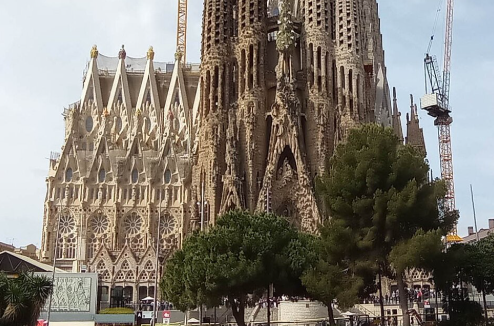
One of the world’s most extraordinary church-building projects has reached a historic milestone, as Barcelona’s Sagrada Família Basilica marks 144 years since construction began. Its towering central structure is now completed externally, in a development that continues to draw global attention to the intersection of Christian faith, architecture, perseverance and human ingenuity.
The Roman Catholic basilica, dedicated to Jesus, Mary and Joseph, began with the laying of its foundation stone on 19 March 1882. Although construction has continued across generations, the project remains unfinished, underscoring the extraordinary scale of a religious undertaking that has outlived its original architect and witnessed profound changes in society, technology and the Catholic Church.
A major breakthrough came on 20 February 2026, when workers installed the final upper section of the cross atop the Tower of Jesus Christ. The installation completed the exterior of the basilica’s central tower, which reaches 172.5 metres, making it the tallest point of the structure.
The milestone was followed by a solemn Mass on 10 June 2026, presided over by Pope Leo XIV, who blessed the tower during a ceremony commemorating the centenary of the death of the architect whose vision shaped the basilica.
A Global Architectural Landmark
The story of the Sagrada Família began with Josep Maria Bocabella, a bookseller and philanthropist who founded the Association of Devotees of Saint Joseph. The association promoted the construction of a church dedicated to the Holy Family and acquired the land for the project in 1881.
The foundation stone was laid the following year, under the initial architectural direction of Francisco de Paula del Villar.
However, the project took a dramatic turn in 1883 when Antoni Gaudí assumed responsibility for the design. He developed a distinctive architectural vision that integrated nature-inspired forms, complex geometry, elaborate sculpture and Christian symbolism.
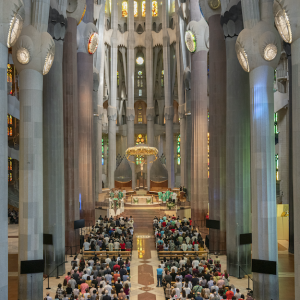
Gaudí’s approach transformed the project into something far more ambitious than a conventional church. Its façades, towers and interior were conceived to communicate religious meaning through architecture, light and artistic craftsmanship.
The basilica became the defining work of his career, reflecting the deep relationship between his Catholic faith and his architectural imagination. The architect died before seeing his dream completed.
Gaudí was born on 25 June 1852 in Reus, Catalonia, and died in Barcelona on 10 June 1926 after being struck by a tram.
He had devoted himself exclusively to the Sagrada Família from 1914 until his death. Yet, despite his extraordinary commitment, he did not live to see the basilica completed.
At the time of his death, only a portion of the vast project had been built. The Saint Barnabas bell tower on the Nativity Façade, completed in 1925, was the only tower finished during his lifetime.
His death did not end the project. Successive architects and generations of builders continued the work, drawing on the designs, photographs, surviving models and other material left behind by the architect.
The continuation of the basilica after Gaudí’s death has become a defining feature of its history: a project sustained beyond the lifetime of the man who gave it its distinctive identity.
Gaudí’s legacy also carries religious significance. On 14 April 2025, Pope Francis declared him Venerable, a formal stage in the Catholic Church’s process of recognising heroic virtue.
The Unfinished Landmark
The completion of the Tower of Jesus Christ’s exterior represents a significant advance, but it does not mean that the entire basilica has been completed.
Other major elements, including the Glory Façade and associated works, remain outstanding. Interior work on the central tower also continues beyond the February 2026 milestone.
The project illustrates the challenges of sustaining a monumental religious building programme across generations while preserving the architectural vision of its original designer.
The Sagrada Família was consecrated by Pope Benedict XVI on 7 November 2010, when it was granted the status of a minor basilica. Parts of the building, including the Nativity Façade and the crypt, form part of the UNESCO World Heritage listing for the Works of Antoni Gaudí.
A Lesson in Faith, Vision and Perseverance
For Christians, the Sagrada Família offers an opportunity to reflect on the relationship between faith, vocation, craftsmanship and perseverance.
Its 144-year construction history also invites reflection on the responsibilities of successive generations to preserve cultural and religious heritage while meeting the demands of the present.
As the Sagrada Família moves towards further stages of completion, the story of Gaudí and the generations who have continued his work remains a striking account of a project whose ambition extended beyond the lifespan of any single individual.
For the millions who visit Barcelona and the faithful who worship there, the basilica stands as a continuing testament to the enduring relationship between religious devotion, artistic expression and the human determination to build something that outlives its creators.