
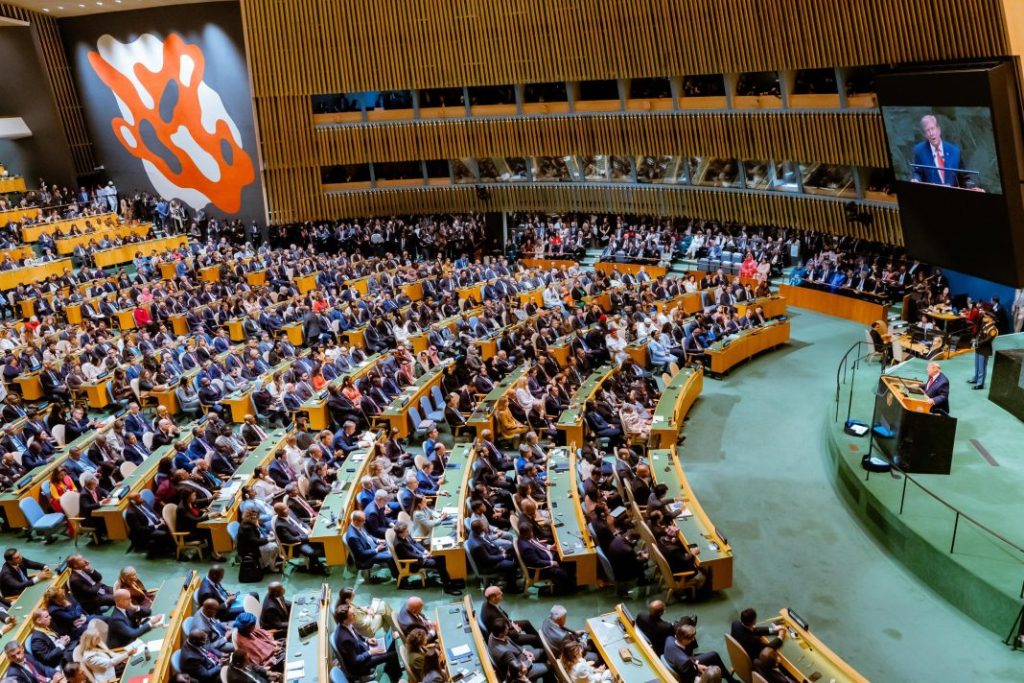
As the 81st Session of the United Nations General Assembly gets underway in New York, United States, the question is louder today than ever: Is the UN still relevant?
Eighty-one years ago, the UN was born out of the ashes of World War II with a noble promise: to save succeeding generations from the scourge of war, to reaffirm faith in fundamental human rights, to promote justice, and to improve life for all peoples.
It was, in many ways, humanity’s best attempt to govern itself. Today, that promise feels fragile. In his final address to world leaders to open the 81st UNGA on Tuesday Sept 22, 2026 UN Secretary General, António Guterres, told the world’s superpowers that “super power has limit”.
His comment came against the backdrop of the failure of the world’s major powers to resolve the problems facing humanity by force of arms or economic strength. Perhaps, Guterres’ speech also aptly captures the incapacity of the United Nations itself to end the misery of human existence, without God.
An Institution Under Strain
The UN’s three pillars — peace and security, human rights, and development — are all under pressure.
In terms of peace and security, Wars in Gaza, Ukraine, Sudan and Myanmar rage on, with the Security Council often paralysed by superpower vetoes. The body created to end wars is struggling to stop them.
Turning to issues of human rights, nations that flagrantly violate human rights now sit on the Human Rights Council. The moral clarity that once defined the UN has become moral relativism.
On international aid and development, at a time of record displacement and hunger, funding for humanitarian aid is shrinking. Major donor nations are cutting aid budgets while needs grow.
For many, especially in the Global South, the UN feels like an old architecture built for a world that no longer exists, a world dominated by a few powers, slow to reform, and most tragically, unable to enforce its own resolutions. So, has the UN outlived its usefulness? The answer is both no, and not quite.
Why the UN Still Matters
As Christians, we believe in order and not chaos. The Apostle Paul in Romans 13 reminds us that God ordains governing structures to restrain evil and promote good.
So, an imperfect UN is better than no UN. It vaccines children through UNICEF, feeds refugees through WFP, and provides a table, however wobbly, where enemies can still talk and resolve grievances. It is a form of common grace that preserves life.
Any peace-loving person wants the UN to succeed in its mandate for peace and human dignity, because every life it saves bears the image of God (Genesis 1:27). But we must not idolize it, no matter how successful it might be in carrying out its mandate.
The Bible never promised that human institutions would usher in lasting peace. In fact, it warns of the opposite as this age draws to a close. Jesus Himself, in Matthew 24, said the signs of the end would be marked by what we see on our news feeds today.
“You will hear of wars and rumours of wars… Nation will rise against nation… There will be famines and earthquakes in various places. All these are the beginning of birth pains” (Matthew 24:6-8).
The Prophet Daniel saw that human kingdoms, no matter how noble, are ultimately fragile, like the statue in Daniel 2, the feet of which was made of iron mixed with clay; impressive but divided and unable to hold together. This is a prophetic picture that points to the era in which the world is at the moment, not at a future time.
The Book of Revelation describes a final attempt by humanity (inspired by the Devil) to create a unified global system to bring peace and prosperity without God, and how that system ultimately fails and becomes oppressive (Revelation 13).
This does not mean the UN is that system. It is not. But it does mean that Scripture cautions us: no human institution, no matter how well-intentioned, can solve the deepest problem of the human heart, which is sin.
What Is the Future of the UN?
The erosion of the UN’s core values – democracy, human rights, and development assistance or aid – is not primarily a structural failure. It is a spiritual symptom. When nations reject the idea that human rights come from God and not from the state, those rights become negotiable. When self-serving policies presented as national interest replace servant leadership, cooperation collapses.
Realistic, Not Cynical Perspective
So, what is the relevance of the UN at 81? First, the UN is relevant as a mirror. Its struggles mirror the state of humanity: brilliant in organisation, broken in unity, and empty in soul. It shows us the limits of man without God.
Secondly, the UN is relevant as a restrainer. For now, God still uses imperfect national and global institutions to hold back complete chaos and to allow the gospel to go to all nations.
Thirdly, the UN is not the hope of believers. Our hope was never in New York. Our hope is in a different throne. While diplomats debate at the UN General Assembly, the Bible tells us of another General Assembly — the assembly of the saints around the throne of the true King whose government will have no end (Isaiah 9:7).
The UN was created to ensure we would never have another world war. The Kingdom of God promises something greater; that there will be no more war at all.
The UN at 81 is still necessary, but it is not sufficient. It can manage conflicts, but it cannot heal the human heart or prevent human beings from going to war. It can deliver aid, but it cannot deliver salvation that brings healing to the human heart.
For Christians, this is a moment not for despair, but for discernment. We pray for our leaders, we support every effort for peace and justice, and we work for human development in our own communities and in the world.
But we do so, knowing that true and lasting peace will not come from a resolution passed in the Security Council. It will come only when the Prince of Peace Himself, Jesus Christ, returns.
Kingdom Times provides kingdom-based interpretations of global events. Stay connected for more faith-based insights, prophetic perspectives, and inspiring stories shaping events across nations.