
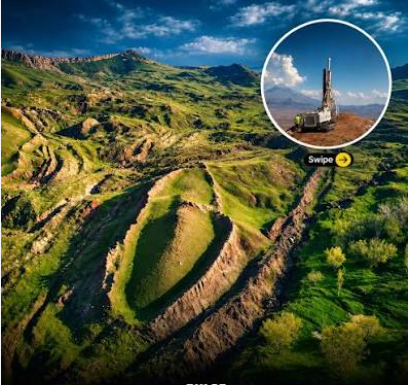
High in the mountains of eastern Turkey, 18 miles south of Mount Ararat, a mystery that has endured for over 4,000 years may finally be giving up its secrets.
Scientists conducting deep scans of the Durupınar site — a giant, boat-shaped mound first spotted in 1959 after an earthquake — have revealed a network of underground passages, walled compartments, and a long central corridor buried deep beneath the surface.
And for the first time, a veteran U.S. radar specialist is declaring the object is not natural rock at all. The formation measures 157 meters in length, or 515 feet.
That measurement has long intrigued Bible researchers because it matches the description given in Genesis 6:15, where God instructs Noah to build a vessel 300 cubits long — a length scholars calculate as between 135 and 157 meters.
For decades, skeptics argued the shape was a trick of nature — a limestone block carved by glaciers and mudslides into the form of a ship. New evidence is challenging that explanation.
Inside the Discovery
An international team working under the banner Noah’s Ark Scans deployed two advanced systems: three-dimensional ground-penetrating radar and a specialized deep-scan technology. It is called Bakhtar Radar, developed by Dr. Khosrow Bakhtar, an Iranian-American engineer with more than 25 U.S. Department of Defence programmes and four decades of subsurface detection experience to his name.
In a preliminary report released October 1, 2026 the team announced four key findings in the boat-shaped formation:
A Central Passageway
Scans detected a continuous void stretching for about 70 meters along the spine of the structure, with smaller linear voids branching outward like corridors.
Structured Compartments
At depths of roughly four to five meters, instruments recorded multiple straight lines, parallel layers, and angular junctions that form chamber-like shapes. Such precise geometry is not typical of natural rock layers.
Layered Levels
The imaging revealed a distinct internal stratification that appears to divide into three separate tiers. This detail caught the attention of theologians because in Genesis 6:16, God specifically commanded Noah to make the Ark “… with lower, second, and third stories.”
No Solid Bedrock
Core samples drilled from inside the mound reportedly contained no solid limestone or bedrock. Instead, researchers say the soil within the structure holds up to three times the amount of organic matter compared to soil outside it, alongside material densities that resemble decayed timber.
Analysis is ongoing
Dr. Bakhtar, who personally deployed his system at the site, said the returns were unlike anything in his career. He explained that his system is designed to filter out natural geological noise, and that a purely geological mass would have been masked.
What remained, he said, was organised and structural, with corridors and voids throughout, and was clearly man-made in origin.
Lead field researcher, Andrew Jones, who has investigated the site for nearly three decades, said the absence of bedrock refutes the idea that the mound is simply a solid rock sculpted by nature.
What Happens Next?
Scientists involved stress that radar alone is not proof. Definitive confirmation will require controlled excavation, laboratory dating of any organic material, and independent peer review.
Turkish authorities currently protect the site and have not authorized large-scale digging.
The significance of all this goes beyond archaeology. Jesus warned, “As it was in the days of Noah, so it will be at the coming of the Son of Man” (Matthew 24:37).
Whether the Durupınar formation is ultimately confirmed as Noah’s Ark or not, one fact can no longer be dismissed: beneath a remote mountain in Turkey lies a vast, organised, chambered object, buried for millennia, that was not made by nature.