


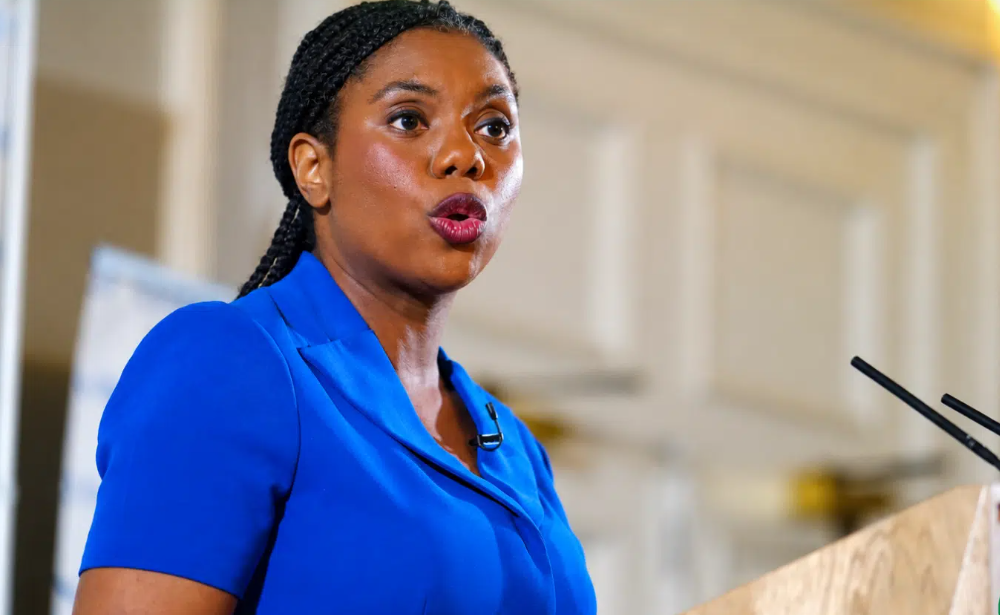
When Kemi Badenoch, leader of the Conservative Party in the United Kingdom, warned recently that “Conflict is coming…”, the statement captured a growing sense of apprehension about the direction in which the world is heading.
Whether understood as a political warning about Britain’s internal security or as a reflection of wider international instability, the words resonate far beyond party politics.
She did not speak out of her imagination. In her speech, she made reference to an intelligence presented to former British Prime Minister, Keir Stammer, that Russia could launch an attack on NATO as soon as 2030. This prompted her warning that “in the next four years, the UK could be at war with the world’s biggest nuclear-armed state.”
Badenoch did not stop there. She recommended spending more money on defence by the UK government, stating that Britain’s allies were already getting prepared for the coming threat. She then warned, “Let’s be honest, conflict is coming. We must act now because the defence of the nation is the first duty of government.”
There is no doubt that the international atmosphere is tense, and the questions confronting humanity are becoming increasingly difficult to ignore. Is the world moving towards another global war? Could the conflicts, geopolitical rivalries and military preparations unfolding across Europe and beyond culminate in a confrontation of unprecedented proportions?
And, for those who look to the Bible for an understanding of world events, are we witnessing developments that bear the unmistakable marks of biblical prophecy?
Getting Ready For Armageddon?
For millions of people, the prospect of a major international conflict is no longer a distant historical possibility. It is a frightening question about the future: could the world once again descend into a war capable of threatening the survival, security and dignity of humanity?
This is a moment that demands more than alarmist headlines or political speculation. It calls for sober reflection on the state of the world, a careful examination of the implications of escalating conflict, and a return to the enduring truths of Scripture.
The rules-based international order that emerged after the Second World War was built, at least in principle, around a determination to prevent another catastrophic global confrontation. Institutions, including the United Nations, were established, diplomatic mechanisms strengthened, and international agreements developed in the hope that disputes between nations could be managed without plunging humanity into another world war.
Yet the persistence of armed conflict, the expansion of military capabilities, the return of aggressive geopolitical competition and the erosion of trust among major powers have raised serious questions about the resilience of that post-war settlement.
Global Tension Builds Up
Russia’s war on Ukraine has fundamentally altered the Europe’s security environment, intensified tensions between Moscow and Western governments, and revived fears of a direct confrontation between nuclear-armed powers.
Meanwhile, as pointed out by Badenoch, military alliances are strengthening their defences, governments are reconsidering their security priorities, and the possibility of miscalculation remains a concern.
Beyond Europe, conflicts and strategic rivalries in the Middle East and other regions demonstrate how quickly local confrontations can acquire international dimensions. Energy supplies, trade routes, food security, migration and financial markets are being disrupted by wars and rumours of war.
It is ruled out that global leaders would collectively decide to initiate a third world war. Rather, it is that several crises, combined with mistrust, nationalist ambitions, military escalation and failures of diplomacy, could produce a chain reaction that becomes increasingly difficult to contain.
Truth is, the possibility of a wider international war cannot be dismissed. Nuclear deterrence, military alliances, cyberwarfare, competition over strategic resources and the growing complexity of international relations create risks that require serious attention.
Time To Ask Tough Questions
Nevertheless, Badenoch’s warning of the possibility of a catastrophic conflict is not proof that such a conflict is inevitable. There is a distinction between warning of danger, in the face of the realities on the ground, and declaring that disaster is certain.
Political leaders may speak forcefully about the need to prepare for conflict because they believe deterrence requires military readiness. Such statements can reflect genuine intelligence assessments, domestic political considerations or mere attempt to make a case for greater defence spending.
The warning that “Conflict is coming…” should prompt citizens and governments to ask difficult questions. Are diplomatic channels being maintained? Are rival powers communicating clearly enough to avoid catastrophic misunderstandings? Are military preparations intended to prevent aggression, or could they inadvertently encourage a dangerous cycle of escalation? And are political leaders doing enough to preserve opportunities for peace?
For Christians, the central concern is not merely whether another world war will occur tomorrow or in 2030. What is certain is that there will be a conflict that will end all conflicts. But beyond this is what the present climate reveals about the fragility of human civilization. And this is what happens when power and national ambition are allowed to overshadow wisdom, restraint and the value of human life.
The world may be approaching a more dangerous period. But humanity must leave room for diplomacy, de-escalation and the possibility that wiser decisions can prevent the worst outcomes.
The End Of The Age?
For Christians, the growing instability of the international system throws up certain biblical passages. Across generations, believers have looked at wars, political upheavals, natural disasters and social breakdown and wondered whether the events of their own time correspond to the signs Jesus described concerning the end of the age in Matthew 24.
Jesus warns (in verses 6-8) that His followers will hear of wars and rumours of wars. He tells them not to be troubled, explaining that such things must occur, but that the end is not yet. He then speaks of nation rising against nation and kingdom against kingdom, alongside famines, earthquakes and other troubles, describing these as the beginning of birth pains.
One element of Jesus’ teaching that must not be overlooked is that wars and rumours of wars are not, by themselves, proof that the end has arrived. Jesus explicitly cautioned His disciples against concluding that every outbreak of conflict meant the immediate end.
His warning remains essential today, especially when frightening headlines can encourage speculation, panic and sensational interpretations of prophecy. The biblical message is, therefore, more nuanced than the assertion that every international crisis signals an imminent apocalypse.
Scripture acknowledges the reality of conflict while warning believers against false certainty about the timing of future events. In Matthew 24:36, Jesus further states that no one knows the day or hour of His return.
This is a vital reminder that Christians may examine the signs of the times and seasons, but they must not claim knowledge of a timetable that Scripture says is unknown. The proper response to prophecy is not to announce dates that the world will end. It is to remain spiritually alert, morally responsible and faithful in the face of uncertainty. In other words, be prepared.
Nothing Is Ruled Out
The imagery of Revelation offers another sobering perspective. Revelation 6 describes the opening of the seals, including the appearance of riders traditionally associated with conquest, warfare, famine and death.
The second horseman, riding a red horse, is associated with the removal of peace from the earth and the terrible violence that follows. The subsequent imagery depicts scarcity, suffering and death on a scale that reflects the devastating consequences of human violence and judgment.
For many Christians, these passages evoke the possibility of a world in which conflict spreads, economic systems are disrupted, food becomes inaccessible to vulnerable populations, and the ordinary conditions necessary for human flourishing begin to collapse.
Given the capacity of the weapon systems currently in the possession of many world powers today, a major international war could produce consequences of this kind on a scale that humanity has never seen.
Nuclear weapons, sophisticated delivery systems, cyberattacks against critical infrastructure and the interconnected nature of the global economy mean that a large-scale confrontation could threaten far more than the armed forces directly involved.
Granted, the book of Revelation is a complex prophetic book, interpreted differently across Christian traditions, what it reveals, for those who believe, is the temporariness of human-centred power structure – as can be seen in the unravelling of the world system today – the consequences of evil, which calls for repentance, and ultimately, the overriding sovereignty of God.
The Christian’s Response
And while the words “Conflict is coming…” may echo through the headlines, the Christian response must also hold firmly to another biblical promise: “Blessed are the peacemakers: for they shall be called the children of God” (Matthew 5:9).
An age of growing uncertainty, as we have today, calls for watchfulness without panic, preparedness without provocation, and faith that refuses to surrender hope. The future is not ours to predict with absolute certainty, but it is our responsibility to pursue peace.
For the Christian, the script does not end with wars or suffering. Revelation ultimately presents a vision of God’s victory over evil and the renewal of creation (Revelation 21:4).
This hope does not minimise present suffering. It provides a reason to resist despair and to continue working for peace, compassion and justice amidst the present darkness.
Badenoch may be a politician and not a prophet but as she hinted, conflict is coming and resilience matters. For believers, it is a call for strong families and local communities, and above all, individual faith that cannot be shaken when the lights go out.
A Kingdom Times perspective on the gathering clouds of war, the future of humanity, and the warnings of biblical prophecy. We are committed to providing Kingdom-based interpretations of unfolding global events. Stay connected to Kingdom Times for more faith-based insights, prophetic perspectives, and inspiring stories shaping the destiny of nations.