


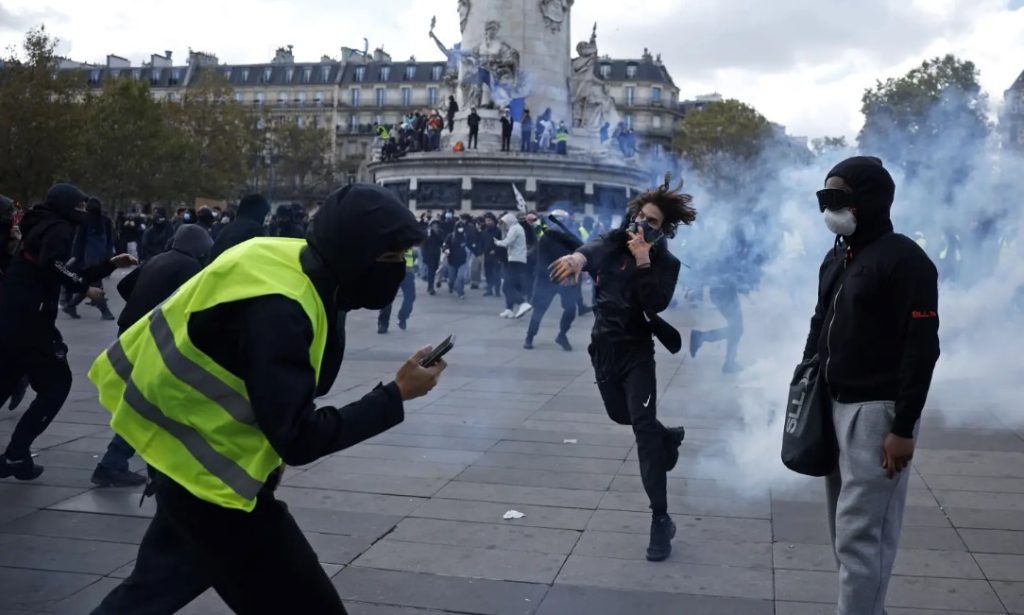
For days, France has been gripped by what began as a school blockade and has now become a national reckoning.
It started September 21, 2026 at Saint-Exupéry High School in Créteil, a working-class suburb of Paris. Students joined striking teachers to blockade their school. The ceiling was collapsing. Rats ran through corridors. There were not enough chairs. The timetable read “8am-6pm. Hours of lessons than sleep.
“By October 6, more than half of France’s 3,700 high schools were hit by blockades or walkouts. 266,000 people marched that day nationwide, 56,000 in Paris alone, according to the Interior Ministry. By last Saturday, that number doubled to 550,000 — students, teachers, parents, pensioners, and Yellow Vest veterans marching together,” reported thehindubusinessline.com.
Reports out of France say that thousands of people have been arrested, a large percentage of them children. A 15-year-old lost his hand to a police grenade, just as a 16-year-old was shot in the eye with a rubber bullet and 14-year-old had his jaw shattered.
The students’ demands are simple: more teachers, repaired buildings, equal funding for poor banlieues. An end to Parcoursup, the university admission system that left 100,000 students without a university place in July.
So far, the government’s response has been tear gas, school closures and a €500 million emergency patch that students call a stop-gap.
Meanwhile, President Emmanuel Macron, has vowed to hold accountable all those found to be responsible for the violence and destruction unleashed on several French cities during the protests.
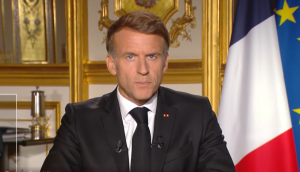
In his nationwide address on the evening of Sunday, Oct. 18, 2026 President Macron promised to hold emergency meeting with the mayors and other leaders to address the issues, but warned that the full weight of the law would be brought to bear on the culprits.
This Is Not Just About Education
According to reason.com, France is spending itself into disorder. The French state spends more per student than many top-performing OECD countries, yet more than one in three 15-year-olds now fail basic proficiency in math — performance is among the lowest ever recorded.
Signalpostnews.com reports that only 8.5% of education funding goes to buildings and equipment. The rest goes to salaries, bureaucracy and pensions. France now spends 14% of its entire GDP on pensions alone. The government needs €43 billion in savings this year. It plans to cut 5% from education over three years while paying more in interest to bondholders than it spends on its schools.
Students see this. As one protester told CNN in Paris: “There’s an accumulation of wealth and power that’s completely out of control… There are billionaires who control the media. We are fighting to change things”.
Overconcentration of power
More than half of all secondary education decisions in France are said to be made centrally by the Ministry in Paris. Parents cannot choose their children’s school — it is assigned by the carte scolaire. A 2020 OECD report says only 10% of decisions are made at the school level.
The Republic is accused of preaching equality, but practicing extreme centralization. When power is concentrated and accountability is distant, institutions rot. Schools crumble first, because children cannot vote.
What Does This Portend For Order
“When the righteous are in authority, the people rejoice: but when the wicked beareth rule, the people mourn”)(Proverbs 29:2). The mourning is now in the streets of France. Three things stand out.
The Social Contract Is Breaking: France was built on liberté, égalité, fraternité — with free, secular, quality education as its sacred promise. When that promise is broken for the poorest suburbs, equality looks like a lie. And when a lie is exposed, rage follows.
Generational Trust Is Crumbling: France’s youth are not apathetic. They are angry that they are being asked to sacrifice their classrooms to pay for a debt crisis they did not create, while pension spending remains untouchable because pensioners vote and students do not.
A nation that sacrifices its children to pay its creditors has inverted biblical order. Psalm 127 says children are the heritage of the Lord, not the budget line to cut.
Political Order Is Fragmenting: President Emmanuel Macron’s centrist project has collapsed the old moderate parties without building a stable coalition. The National Assembly is in chaos. The far-left La France Insoumise and far-right National Rally are both harvesting this anger ahead of the 2027 presidential election.
The pattern France fears is not one protest, but a rhythm — weekly mobilisation that survives weather, exams and news cycles. When students, unions, pensioners and the forgotten suburbs start comparing notes, it is no longer about school funding. It is about who bears the sacrifice.
France is not facing a student crisis. France is facing a stewardship crisis. You cannot centralize all power in Paris, outsource all responsibility to contractors, close hundreds of schools, arrest thousands of children, and still call it order. That is control. And control without justice never holds.
As Scripture warns in Isaiah 10:1-2 — “Woe unto them that decree unrighteous decrees… to turn aside the needy from judgment.” If France does not listen to its 17-year-olds now, it will have to contend with its 25-year-olds in 2027 — at the ballot box, and possibly again on the streets. A nation that refuses to repair its classrooms will soon have to repair its streets, as is the case in France today — a warning to other countries towing similar paths.