
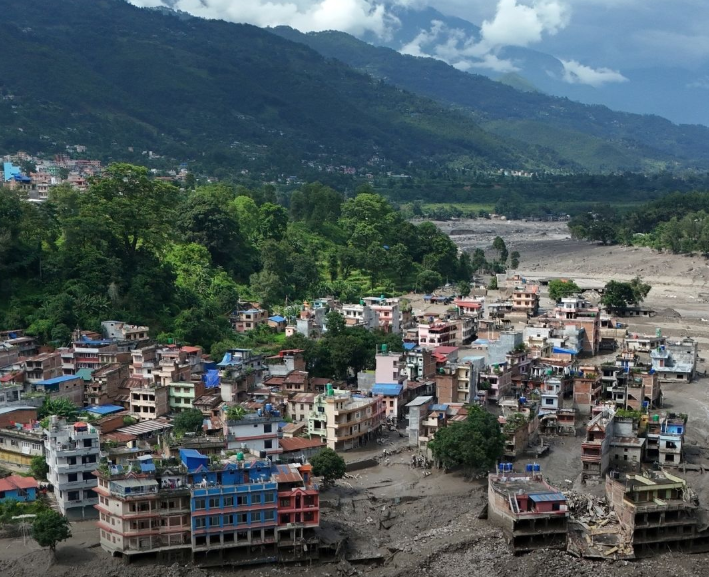
A wall of ice, mud and rock collapsed in the Himalayas this week and unleashed a torrent that has left communities on both sides of the Nepal-China border in mourning.
The disaster struck on Wednesday, August 26, 2026, when the lower part of a glacier gave way along the Lhende Khola River on the Nepal-Tibet border. The avalanche swept down the valley, slamming into Gyirong Port in Tibet and into Nepal’s Rasuwa and Nuwakot districts. And within minutes, roads, bridges, houses and hydropower projects were washed away.
The Human Cost
The numbers are still rising. As of Friday August 28, authorities reported at least 362 people dead, with other counts putting the toll at over 390 and local media reporting over 500 deaths. Nepal police confirmed 157 bodies recovered on the first day, while China reported 3 dead in Tibet’s Gyirong County.
The missing are far more. The count has now climbed to more than 2,000 people still unaccounted for, including nearly 1,500 across both countries. Among them are around 750 foreigners, including 177 Indians on pilgrimage to Kailash Mansarovar, 63 Americans, 53 Ukrainians, and citizens of 20 other nations. A Japanese family of five is also reported to be among the missing.
What Triggered It
Scientists say a section of glaciers about 1 km wide, and 2 km long broke off and fell 1.2 km to the valley floor. Initial reports suggested an earthquake, but the U.S. Geological Survey said the tremor was seismic energy from the collapse itself.
The region is increasingly vulnerable. Nepal’s mountains have lost close to one-third of their ice in just over 30 years due to global warming, according to the UN. Scientists noted that snow had melted rapidly 24 hours before the disaster.
Now, a new danger looms. A barrier lake has formed at the site, with 3 million cubic meters of water expected to flow in over the next three days. Nepal and China have warned residents to stay away from riverbanks, with peak risk expected around September 1, 2026.
Background of Prophecy
For many believers, disasters of this scale echo words spoken by Christ about the end of the age.
“And there shall be signs in the sun, and in the moon, and in the stars; and upon the earth distress of nations, with perplexity; the sea and the waves roaring” Luke 21:25.
“For nation shall rise against nation… and there shall be famines, and pestilences, and earthquakes, in divers places. All these are the beginning of sorrows” Matthew 24:7-8.
The Himalayan floods are not an earthquake, but they are part of a pattern Jesus described: creation itself groaning. Glaciers melting, rivers rising, nations in distress, and the suddenness with which life is swept away.
In Nepal, many of the missing were pilgrims, people on a sacred journey to Kailash Mansarovar. In Tibet, Gyirong Port, a gateway for trade and faith, was buried. The flood did not distinguish between tourists and locals, believers and non-believers.
The Bible calls us not to fear, but to watch and pray. “When these things begin to come to pass, then look up, and lift up your heads; for your redemption draweth nigh” Luke 21:28.
What Comes Next
Search and rescue continue, but officials expect the death toll to rise.
For the Church in Asia and around the world, the call in this moment is two-fold: to weep with those who weep, and to point to the hope that does not fail. Food, shelter, and prayer are urgently needed for displaced families in Rasuwa, Nuwakot, Dhading and Gorkha.
As the waters recede and the mud settles, the mountains remain — and so does the promise of the One who calms the storm.
“God is our refuge and strength, a very present help in trouble. Therefore, will not we fear, though the earth be removed, and though the mountains be carried into the midst of the sea” Psalm 46:1-2.