


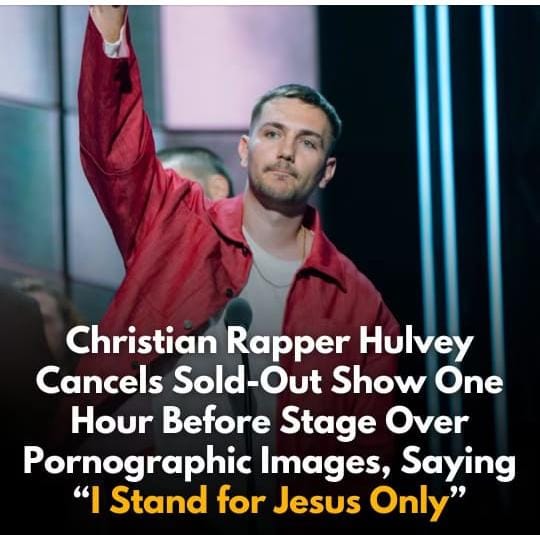
Dove Award-winning Christian rapper Hulvey has reportedly cancelled a sold-out concert in Amsterdam barely an hour before he was scheduled to take the stage after discovering graphic sexual images and sexually explicit objects displayed inside the venue.
The decision that has drawn attention to the difficult choices Christian artists may face when their professional commitments conflict with their religious convictions, putting faith above performance and calling for purity, forgiveness and courage to obey God
According to the account of the incident, Hulvey and his team asked venue officials to cover the material before the performance. However, the request was largely rejected, leaving the rapper to make a decision that meant disappointing fans, abandoning a highly anticipated show and potentially absorbing the financial and reputational consequences of a last-minute cancellation.
Hulvey ultimately chose not to perform, explaining that he could not, in good conscience, allow the audience, which included children reportedly present among concertgoers, to be exposed to material he considered incompatible with his Christian convictions.
“There is one that I answer to, and that’s Jesus,” he said.
The statement captured the central issue behind the cancellation: for Hulvey, the decision was not simply about the suitability of a concert venue or a disagreement over its displays. It was about the limits of professional obligation when an artist believes that proceeding would compromise a deeply held commitment to Christ.
A Sold-Out Show Abandoned at the Eleventh Hour
Cancelling a sold-out concert is rarely a straightforward decision. It can mean financial losses, disappointed ticket holders, logistical complications and difficult conversations with promoters, event organisers and venue management.
For an established recording artist, the consequences can extend beyond a single evening, potentially affecting professional relationships and future bookings.
Yet Hulvey reportedly made the decision after discovering explicit sexual imagery and objects displayed within the venue shortly before the scheduled performance.
His team sought a practical solution, asking officials to cover the material rather than immediately abandoning the event. According to the account, however, venue representatives refused to cover most of the displays.
With the disagreement unresolved and the concert approaching, Hulvey decided that going ahead was not an option he could accept.
The timing made the decision particularly consequential. The concert was reportedly sold out, and the cancellation came approximately one hour before he was due to perform, when fans would already have made arrangements to attend.
Nevertheless, the rapper’s reported response suggests that he considered the matter more important than preserving the evening’s programme.
His decision also raises a broader question for Christian performers working in diverse cultural environments: what should an artist do when the conditions surrounding a performance become inconsistent with the values that define the artist’s public identity and personal faith?
For Hulvey, the answer was to withdraw rather than proceed under circumstances he believed crossed a moral boundary.
‘There Is One That I Answer To’
Hulvey’s declaration that Jesus was the ultimate authority to whom he answered provides the clearest insight into his reasoning.
For Christians, the statement reflects a foundational conviction that faith is not merely a private identity or a label attached to music, ministry or public appearance. It is a commitment intended to influence decisions, conduct and relationships, including situations in which obedience may come at a personal cost.
In the entertainment industry, artists routinely navigate competing expectations involving audiences, commercial partners, event organisers, cultural differences and professional obligations. Christian artists face those same pressures while seeking to remain faithful to the convictions they publicly profess.
The Amsterdam incident, as described, placed those competing demands in direct tension.
Hulvey had a concert to deliver and fans who expected to see him perform. Yet he believed the environment presented a problem that could not be resolved through the compromise proposed by his team.
Rather than separate his performance from the setting in which it would take place, he treated the venue’s environment as part of the decision itself.
His response challenges the notion that Christian commitment should be confined to lyrics, stage appearances or public declarations of belief. It suggests that faith may also require decisions that disrupt professional plans and carry tangible consequences.
The significance of the reported cancellation, therefore, lies not simply in the fact that a concert did not take place, but in the reason the artist gave for refusing to perform.
Children and the Question of Responsibility
The reported presence of children among the concertgoers added another dimension to the dispute.
When an event is promoted as a Christian music experience or attracts families, questions about the suitability of its environment can become particularly important. Parents may reasonably expect organisers to communicate relevant information about a venue and take appropriate steps to address concerns about content that could be unsuitable for younger attendees.
The episode highlights the importance of communication between artists, promoters and venues before an event takes place. Advance inspections, clear agreements about the performance environment and contingency arrangements can help prevent disagreements from escalating shortly before a show.
It also illustrates the challenge of managing events in spaces whose established uses, displays or commercial identities may differ from the expectations of a visiting performer.
For Christian artists, particularly those whose audiences include young people and families, such considerations may be central to determining whether a venue is appropriate.
However, the precise circumstances surrounding the Amsterdam venue, the nature of the displays and the terms of the event agreement would need to be independently established before drawing broader conclusions about the responsibilities or conduct of the parties involved.
Conviction Without Contempt
One of the most striking elements of Hulvey’s reported response was his insistence that he did not hate the venue staff. That distinction matters.
Taking a moral position does not necessarily require hostility towards people who disagree with it. An individual can object strongly to a situation, decline to participate in it and still recognise the dignity of those involved.
According to the account, Hulvey spoke to fans outside the venue after the cancellation. Rather than presenting the incident solely as a confrontation with management, he also expressed a desire for purity, forgiveness and the courage to obey God when obedience becomes difficult.
His reported comments point towards a Christian response that combines conviction with humility: refusing to compromise on a matter of conscience without turning disagreement into personal hatred.
This approach is significant in a climate where disagreements over morality, sexuality, religion and cultural expression can quickly become adversarial.
For Christians, the challenge is not only to identify what they believe is right, but also to consider how they respond when their convictions are challenged.
A firm boundary and a spirit of compassion need not be mutually exclusive. Indeed, the Christian understanding of truth is inseparable from the call to love one’s neighbour, even in circumstances of disagreement.
A Costly Decision for a Christian Artist
Hulvey reportedly acknowledged that he had never cancelled a show before. That detail underscores the unusual nature of the decision and the professional pressure involved in making it at such short notice.
His stance presents a difficult question for artists who build their careers around an explicit religious identity: what happens when maintaining that identity conflicts with an opportunity they have worked hard to secure?
For some, the temptation may be to proceed, reasoning that the performance itself remains worthwhile despite the surrounding circumstances. Others may consider withdrawal necessary where participation would violate a fundamental conviction.
Such decisions require careful judgment. Not every disagreement with a venue necessarily demands cancellation, and the circumstances of each case matter. Artists must assess the nature of the concern, the available alternatives, the potential effect on audiences and whether a workable solution can be reached.
The decision consequently offers a discussion point about the practical meaning of integrity: whether professed convictions remain decisive when upholding them becomes inconvenient or costly.
What the Bible Says About Conviction and Obedience
Hulvey’s reported declaration that Jesus was the one to whom he answered resonates with several biblical principles concerning conscience, holiness and obedience.

In Acts 5:29, Peter and the apostles declare that they must obey God rather than human beings when their obedience to God conflicts with human demands. The passage arises from a specific confrontation involving the apostles’ proclamation of the Gospel, but its central theme has long informed Christian reflection on the priority of obedience to God.
Similarly, Romans 12:2 urges believers not to be conformed to the pattern of the world but to be transformed through the renewing of their minds. The verse calls Christians to discern God’s will rather than simply accept prevailing expectations.
First Corinthians 10:31 offers another principle: whatever believers do, including ordinary activities such as eating and drinking, should be done for the glory of God.
Taken together, these passages invite Christians to consider whether their everyday decisions reflect their professed faith. They also challenge believers to examine the motivations, consequences and moral implications of their choices.
At the same time, biblical discernment requires wisdom. Christian conviction should not be confused with impulsiveness, and standing for one’s beliefs does not remove the responsibility to act fairly, speak truthfully and treat others with respect.
The New Testament’s call to holiness is accompanied by its call to humility, patience, love and self-control.
Hulvey’s reported emphasis on forgiveness and the absence of hatred towards venue staff reflects that complementary dimension of Christian conduct.
The issue, from this perspective, is not simply whether a Christian artist should say no. It is how that decision is reached, what principles inform it and how the artist treats others in the process.
The incident also raises questions about the meaning of Christian witness in public life. Is Christian witness limited to delivering a message from the stage, or does it also involve the circumstances in which the message is delivered?
There is no single answer for every situation. Context, motive and the nature of the disagreement matter. Yet the question remains relevant for Christian artists whose music, public image and professional decisions are understood by audiences through the lens of faith.
For believers who regard their artistic work as a form of ministry, the distinction between performance and personal conviction may be difficult to sustain when the surrounding circumstances directly challenge their conscience.
Hulvey’s reported decision illustrates one response to that tension, that is withdrawing from an event when the conditions he encountered could not be reconciled with his beliefs.
Cost of Integrity
Whether observers agree with his decision or not, the episode raises a question that extends beyond music: what does integrity require when doing what one believes is right comes at a cost?
For Christians, it is a question that reaches into workplaces, business relationships, public service, creative industries and private life.
Faith is easy to profess when it carries no consequence. The more difficult test comes when a person must choose between convenience and conviction, popularity and principle, or professional opportunity and personal conscience. Hulvey’s reported cancellation has placed that question before his fans and the wider Christian community.
In all this, the broader lesson is worth considering: conviction must be more than a public declaration, it should also be accompanied by wisdom, accountability and love.