

The journey of the woman and the female voice started from the Garden of Eden and is littered all over the Scriptures. Let’s look at some important lessons about their lives, faith and identity.
One of the lessons is that not every woman will express her purpose, calling, strength or influence the same way. Understand this and find peace because it is perfectly all right.
The Proverbs 31 Model
For a long time, Proverbs 31 has been presented as the defining biblical standard of womanhood. Its description of a virtuous woman has inspired generations of women to embrace diligence, wisdom, generosity, strength, entrepreneurship and reverence for God.
These are admirable virtues. However, the Bible does not present only one model of a godly woman. Across its pages, we encounter women of different temperaments, backgrounds, experiences, responsibilities and spiritual assignments.
Some led nations and confronted kings. Others served quietly, nurtured families, demonstrated extraordinary courage, influenced communities or became instruments of God’s redemptive purposes.
Some experienced triumph, while others endured grief, rejection, difficult choices and personal failures. Their stories remind us that godly womanhood is not a competition in which every woman must reproduce another woman’s journey. It is about discovering one’s identity in God and faithfully responding to His purpose.
Here Comes Deborah
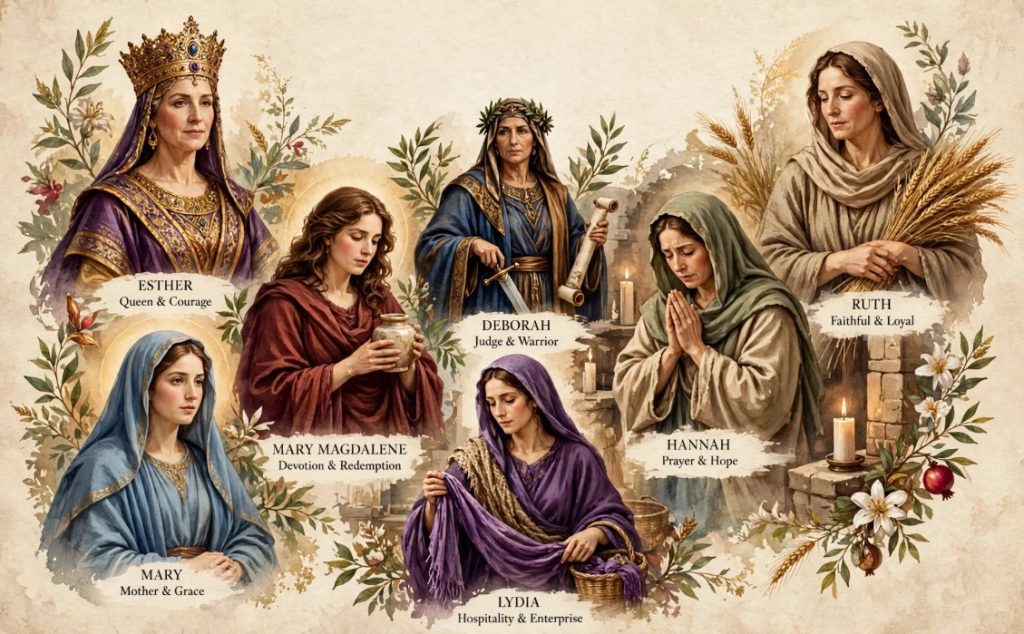
Consider Deborah, for instance. In a period when Israel was oppressed, Deborah emerged as a prophetess and judge. She provided leadership, exercised discernment and summoned Barak to confront Israel’s enemies.
Her story demonstrates that women can occupy positions of spiritual and public leadership and play significant roles in moments of national crisis (Judges 4–5). Deborah represents courage, conviction and leadership in action.
Woman Of Strong Conviction
Then there is Ruth, whose story offers another expression of strength. A Moabite widow, Ruth chose to remain with her mother-in-law, Naomi, despite the uncertainty of her future.
Her declaration of loyalty, “Where you go I will go, and where you stay I will stay” (Ruth 1:16) remains one of Scripture’s most memorable expressions of commitment.
Ruth’s life demonstrates that faithfulness, humility and steadfast love are powerful qualities, even when they are exercised away from public attention. Her story eventually became part of the lineage of King David and, in the New Testament genealogy, Jesus Christ (Matthew 1:5).
Esther The Queen
Esther presents yet another dimension of biblical womanhood. A Jewish woman who became queen of Persia, Esther found herself in a position of extraordinary influence at a moment when her people faced destruction.
Initially hesitant because approaching the king without an invitation could cost her life, she eventually demonstrated remarkable courage.
Her uncle Mordecai’s question, “And who knows whether you have come to the kingdom for such a time as this?” (Esther 4:14), challenges readers to consider the responsibility that accompanies influence and opportunity. Esther reminds us that position is not merely a privilege; it can also be an assignment.
Faithful Mary
Mary, the mother of Jesus, offers a different but equally significant example. When the angel Gabriel announced God’s plan for her, she responded with submission and faith: “Behold the maidservant of the Lord! Let it be to me according to your word” (Luke 1:38).
Mary did not have a complete understanding of everything that lay ahead, but she trusted God’s word. Her story illustrates the beauty of surrender, obedience and willingness to participate in a divine purpose beyond personal understanding.
The Pain of Waiting
Hannah’s story speaks to women who understand the pain of waiting. Deeply distressed by her inability to have a child, she poured out her heart before God in prayer. Her anguish was so profound that Eli, the priest, initially misunderstood her.
Yet Hannah persisted in prayer, and God eventually answered her request with the birth of Samuel, whom she dedicated to the Lord (1 Samuel 1–2). Her experience reminds us that seasons of waiting do not necessarily indicate the absence of faith. Sometimes, faith is most visible in the tears and prayers nobody else sees.
The Wise Woman
Abigail demonstrates the importance of wisdom, emotional intelligence and decisive action. When her husband Nabal foolishly offended David, Abigail acted quickly, taking provisions to meet David and prevent bloodshed. Her discernment and intervention averted a potentially disastrous confrontation (1 Samuel 25).
She reminds us that strength does not always announce itself through confrontation. Sometimes, the wisest person in the room is the one who knows when and how to intervene.
Miriam the Worshipper
Miriam, the sister of Moses and Aaron, also occupies an important place in Israel’s history. Described as a prophetess, she led the women in worship after the Israelites crossed the Red Sea, celebrating God’s deliverance with tambourines and songs (Exodus 15:20–21).
Her life also contains a difficult episode involving criticism of Moses, for which she faced God’s discipline (Numbers 12). Miriam’s story therefore presents both the significance of worship and leadership and the importance of humility and accountability.
Courageous Rahab
Rahab’s story is particularly encouraging to anyone who believes that their past has disqualified them from a meaningful future. A woman living in Jericho, Rahab sheltered Israelite spies and helped them escape. Her faith and actions contributed to the preservation of her household when Jericho fell (Joshua 2; 6:22–25).
She is subsequently mentioned among the people of faith in Hebrews 11:31 and in the genealogy of Jesus in Matthew 1:5. Her story demonstrates that a person’s background does not have to be the final definition of their life.
Joy After Grief
Naomi, on the other hand, represents the painful reality of loss and the possibility of renewed hope. Having lost her husband and both sons, she returned to Bethlehem feeling bitter and empty. Yet, through Ruth’s loyalty and the eventual marriage of Ruth to Boaz, Naomi experienced a measure of restoration and joy.
The women of Bethlehem celebrated the birth of Ruth’s son, Obed, and recognised the significance of this new chapter in Naomi’s life (Ruth 1–4). Her story reminds us that grief is real, but it does not have to be the final chapter.
Entrepreneurship And Hospitality
Lydia of Thyatira offers an example of entrepreneurship, hospitality and purposeful influence. Described in Acts 16 as a seller of purple goods, she was a businesswoman whose heart the Lord opened to receive Paul’s message.
Following her baptism and that of her household, she welcomed Paul and his companions into her home. Her hospitality subsequently provided a place of support for the emerging Christian community in Philippi. Lydia reminds us that business, resources and professional influence can become instruments of service to God and others (Acts 16:11–15, 40).
Womanhood & Knowledge
Priscilla, together with her husband Aquila, was another woman whose contribution to the early Church deserves recognition. They were tentmakers who worked alongside Paul and became important partners in Christian ministry.
When they encountered Apollos, who was preaching with considerable knowledge but incomplete understanding, they took him aside and explained the way of God more accurately (Acts 18:24–26). Priscilla’s story highlights the importance of knowledge, discipleship, collaboration and the responsibility to strengthen others in faith.
Transformation & Commitment
Mary Magdalene is another remarkable example. The Gospels identify her as a woman from whom Jesus had cast out seven demons. She became one of His followers and was present during significant moments of His ministry, crucifixion and resurrection.
She was among the first to encounter the risen Christ and was sent to announce the news to His disciples (Luke 8:1–3; John 20:11–18). Her story is one of transformation, devotion and the privilege of bearing witness to the resurrection.
However, Scripture also gives us cautionary examples. Jezebel, the wife of King Ahab, is remembered for promoting the worship of Baal, persecuting God’s prophets and exercising destructive influence over the kingdom of Israel (1 Kings 16:29–33; 18:4; 21).
Her story is a warning about the destructive consequences of idolatry, manipulation, abuse of authority and unaccountable power. It should not be used carelessly as a label for women who are outspoken, ambitious or simply disagree with others. The biblical account presents specific actions and choices that deserve examination, not a licence to stereotype women.
Taken together, these women reveal the richness of biblical narratives about womanhood. They were not identical in personality, circumstances, responsibilities or experiences.
Some were queens, some widows, some businesswomen, some prophets, some wives and mothers, and some women whose lives were marked by extraordinary personal transformation.
Their stories also remind us that biblical womanhood is not simply about occupying a particular social position. It is about character, faith, obedience, wisdom, courage, humility and our relationship with God.
Life Lessons
This brings us back to Proverbs 31. The passage, particularly Proverbs 31:10–31, describes a woman of noble character. She is hardworking, wise, compassionate, industrious, generous and God-fearing. She manages resources, considers the needs of her household, engages in trade, helps the poor and speaks with wisdom. Her value is not measured merely by outward appearance or social recognition but by her character and reverence for God.
She is an inspiring biblical portrait, not a reason to diminish every other expression of godly womanhood in Scripture. Indeed, the qualities celebrated in Proverbs 31 can be reflected in women whose stories are very different from one another.
The important lesson is not that every woman must become Deborah, Ruth, Esther, Mary, Hannah, Abigail, Miriam, Rahab, Naomi, Lydia, Priscilla or Mary Magdalene. Neither should we romanticise the struggles of these women or assume that every woman must have a dramatic biblical-style assignment to be valuable.
Rather, we should recognise that God works through people in different circumstances and that faithfulness can take many forms.
Some women are called to public leadership; others exercise influence within their families, professions, churches and communities. Some are building businesses, developing institutions, raising children, mentoring young people, advocating for justice, serving the vulnerable or preserving the values and heritage of their communities. These responsibilities should not be placed in unnecessary competition with one another.
There is also a lesson in the cautionary stories of Scripture. Influence must be accompanied by character. Leadership requires accountability. Courage must be guided by wisdom, and ambition must never become an excuse for pride or the abuse of others.
In a world that frequently measures women against carefully constructed social expectations, the biblical accounts invite us to look beyond comparison. A woman’s worth is not determined by whether her life resembles another woman’s testimony, career, marriage, motherhood experience or public visibility.
The question is whether she is growing in faith, developing godly character and using the opportunities entrusted to her responsibly.
The Bible does not give us one-dimensional women. It gives us a rich account of women who led, served, worshipped, worked, waited, suffered, learned, made mistakes and experienced God’s grace.
Their lives remind us that no single woman has to become the standard against which every other woman is judged.
You do not have to imitate another woman’s journey to fulfil God’s purpose for your life. Learn from the faith of Ruth, the courage of Esther, the leadership of Deborah, the wisdom of Abigail, the hospitality of Lydia and the devotion of Mary Magdalene. But remember that their stories point beyond themselves to a God who works through imperfect human lives.
Ultimately, the goal is not to become another woman. It is to become the woman God calls you to be: a woman of faith, integrity, wisdom, courage and love.
The challenge is to discover your place in His story and live it faithfully.