


Every three seconds, a girl somewhere in the world is married before she turns 18. The United Nations Population Fund (UNFPA), in a statement marking the 2026 International Day of the Girl Child, warned that child marriage continues to cut short girls’ childhoods, limit their opportunities and expose them to serious health, social and economic risks.
According to the UNFPA, the practice remains rooted in factors including economic hardship, longstanding traditions and the desire of some parents to protect their daughters.
In Nigeria, the figures underline the gravity of the problem. According to UNICEF, more than 3.7 million women aged 20 to 24 were married before their 18th birthday. Data from the 2024 Demographic and Health Survey put the national prevalence at 33.4 per cent among young women in this age group, with rates approaching 50 per cent in the North-East and North-West.
Behind these statistics are girls whose education might be interrupted, freedom curtailed and whose ambitions might be sacrificed to poverty, social expectations and decisions made on their behalf.
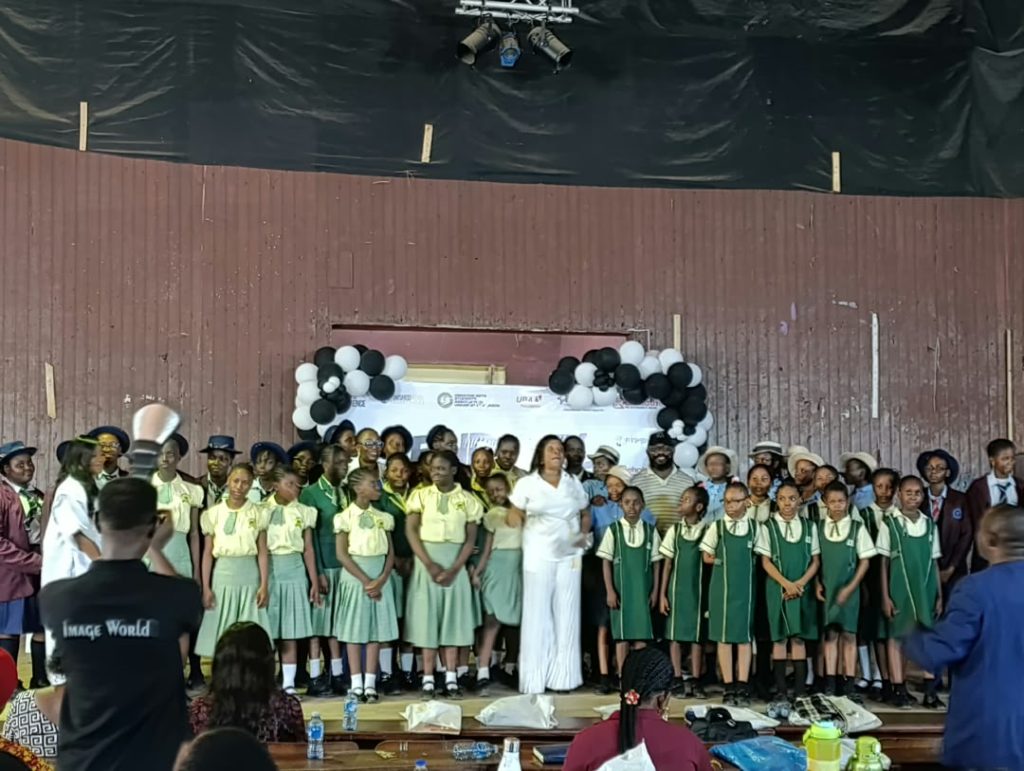
It was against this backdrop that advocates, educators and professionals gathered at the Creative Arts Theatre, University of Lagos, on Thursday, October 15, for the International Girl Child Conference 2026. The speakers urged families, communities and governments to protect girls’ rights, invest in their education and give them the freedom to determine their futures.
‘End Girl Marriage, Give Her a Future’
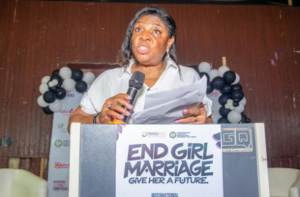
The conference, tagged “End Girl Marriage, Give Her a Future”, was convened by literary scholar, editor and publisher, Lechi Eke. It brought together speakers who examined child marriage not simply as a harmful tradition, but as a barrier to girls’ rights, education, personal development and economic independence.
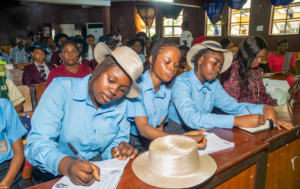
The central message was that ending child marriage requires more than preventing a wedding. It means creating the conditions in which girls can learn, grow, make decisions and pursue lives beyond the expectations imposed on them.
In her address, Eke challenged the distinction between protecting a girl and controlling her life, arguing that the two are too often confused.
“Protecting her space: ‘I will keep you safe so you can become all you need to be.’ Controlling her space: ‘I will marry you off so I no longer have to worry about you,’” she said, noting that “One gives her the future, the other steals the future.”
For her, a girl’s childhood should be a period in which she is free to learn, play, explore her interests and develop her potential, rather than one prematurely brought to an end by marriage.
She acknowledged that marriage and motherhood can be meaningful parts of life, but argued that they should not be presented as a girl’s only path to fulfilment.
“Marriage and motherhood are beautiful, they are great, but there is more to life than becoming a 19-year-old mother,” she said.
The factors that push girls into early marriage, are often connected. Poverty and financial pressure can lead families to see marriage as a solution to their difficulties, while cultural expectations and gender inequality reinforce the belief that a girl’s future should be determined by others.
These pressures show why efforts to end child marriage cannot focus solely on the decisions made at the point of marriage. They must also address the economic and social conditions that make families consider it an option.
Keeping girls in school, providing access to skills and creating opportunities for economic independence are, therefore, essential parts of the response.
Legal Protection on Paper
The conference also drew attention to the gap between legal protections and the experiences of girls in communities where child marriage persists. Nigeria has legal frameworks intended to protect children, including the Child Rights Act of 2003.
However, the domestication and implementation of the Act across states remain challenges. The existence of legislation does not automatically guarantee that a girl facing pressure to marry will receive protection.
Families, schools, law enforcement agencies, community leaders and public institutions all have roles to play in ensuring that child marriage is not dismissed as a private or purely family matter.
Protecting girls also requires listening when they report abuse or express fear about decisions being made for them. Without accessible support systems and adults willing to take their concerns seriously, legal rights may remain beyond their reach.
Educator and child development specialist, Titi Nabena, reinforced the importance of recognising girls as individuals with potential beyond traditional expectations.
“You are not just to be raised to become future mothers,” she told the girls, encouraging them to see themselves as future professionals, leaders, educators and whatever else they desired to become.
Know Your Worth
She urged girls to know their worth, understand their rights and recognise that their futures matter. She encouraged them to speak out when they experience abuse or encounter situations that make them uncomfortable, and to seek help from trusted adults when they cannot turn to their parents.
“Speak out. Speak out,” she stressed.
For Obehi Enahoro, an engineer and youth development expert, it was important to approach the issue from the perspective of possibility. She urged girls to imagine the people they want to become and begin preparing for those futures.
Reflecting on her own career journey, Enahoro spoke about how her ambitions changed as she gained knowledge and discovered new interests. What began as an interest in accounting eventually led her towards chemical engineering after she learnt more about physics and opportunities in the oil and gas industry.
“Everyone can help you, but you have to chart your own course,” she said.
She encouraged girls to picture themselves ten years into the future and think deliberately about the steps needed to get there. She urged them to work diligently, take their studies seriously and remain open to opportunities.
“It is okay to dream,” she said, warning against allowing society’s expectations to confine girls to predetermined roles. “Because it doesn’t make sense when your whole life comes to an end because you are trying to fit into what society is forcing you to fit into.”
On his part, Ugochukwu Ezeagwula, growth strategist and special guest of honour, urged girls to look beyond the circumstances in which they were raised. “Where I come from, where I grew up, can never be a determinant of where I end up,” he said.
His message underscored the importance of resilience, diligence and making the most of opportunities, even when a person’s circumstances appear limiting.
The speakers’ emphasis on personal ambition did not diminish the responsibility of families, communities and government to protect girls. Rather, it reinforced the point that girls need both the freedom to dream and the support that makes those dreams achievable.
It was generally agreed that boys and men, too, must be part of the conversation, learning to value girls as equals and respecting their choices.
The message from the International Girl Child Conference 2026 was that a girl’s future should not be decided for her before she has had the chance to discover what she can become. She must be allowed to learn and to choose.