


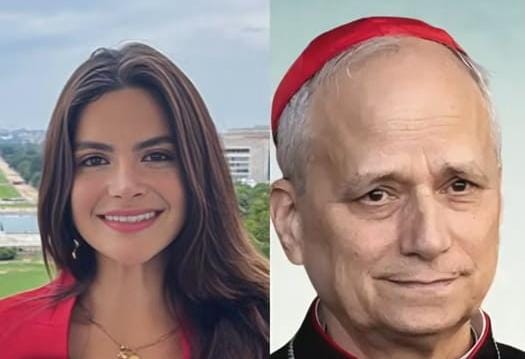
A controversy has emerged following remarks attributed to Texas Republican candidate Valentina Gomez, who reportedly criticised Pope Leo XIV for not visiting Nigeria amid persistent attacks on Christian communities.
Gomez was quoted in a statement circulating on social media as questioning the Pope’s priorities, contrasting his visit to a mosque in Algeria and an encounter with Ferrari’s new electric vehicle with his absence from Nigeria, where thousands of Christians have been killed in attacks linked to religious persecution.
“The Pope has time to drive a Ferrari, visit a mosque, but he can’t visit Nigeria where his fellow Christians are being slaughtered by Muslims,” Gomez was quoted as saying.
The reported criticism has drawn attention to Nigeria’s prolonged security crisis, particularly attacks on Christian communities, churches and rural settlements in parts of the country.
Nigeria’s Persecution Crisis
Nigeria remains one of the countries most affected by violence against Christians. Open Doors, an international Christian persecution monitoring organisation, ranked Nigeria seventh on its 2026 World Watch List, which identifies countries where Christians face severe persecution.
The organisation estimated that 3,490 Christians were killed for their faith in Nigeria during its reporting period, underscoring the scale of the crisis confronting vulnerable communities.
Attacks attributed to jihadist groups, including Boko Haram and the Islamic State West Africa Province, as well as violence involving armed groups in rural communities, have contributed to the insecurity.
However, Nigeria’s security crisis is complex. Religious persecution, communal conflicts, banditry, disputes over land and resources, and broader governance and security challenges intersect in different parts of the country. Not every attack can be attributed solely to religious motives, and civilians of different faiths have suffered devastating losses.
For many Christian leaders and advocacy groups, the continuing attacks have strengthened calls for more decisive action by the Nigerian government and greater international attention.
Beyond Condemnation: The Call for Action
The controversy raises a broader question about the responsibility of influential religious leaders to demonstrate solidarity with communities facing persecution.
While the Vatican has consistently promoted peace, religious freedom and human dignity, some advocates argue that direct engagement with affected communities could reinforce international concern and draw renewed attention to their plight.
Pope Leo XIV’s visit to the Great Mosque of Algiers on April 13, 2026, formed part of his apostolic journey to Africa. His engagement with Muslim religious leaders reflected the Vatican’s emphasis on interfaith dialogue and peaceful coexistence.
Such engagement does not necessarily diminish concern for persecuted Christians. Rather, it reflects the wider challenge of defending religious freedom while promoting peaceful relations among people of different faiths.
Nevertheless, calls for the Pope to visit Nigeria and engage directly with victims, church leaders and government authorities highlight the expectations some Christians have of the global Church’s leadership.
A papal visit could provide an opportunity to draw international attention to affected communities, encourage dialogue with Nigerian authorities and reinforce calls for the protection of religious minorities. Any such visit, however, would need to be considered within the broader realities of security, diplomacy and pastoral priorities.
The Need to Protect Every Life
Beyond the controversy surrounding Gomez’s reported remarks, the central issue remains the safety of Nigerians living under the threat of violence.
Churches and Christian communities must be protected from targeted attacks, while perpetrators of religiously motivated violence must be investigated and held accountable. Equally, the protection of every Nigerian, irrespective of religion or ethnicity, must remain a fundamental responsibility of the state.
For families who have lost loved ones, communities forced from their homes and worshippers living in fear, expressions of sympathy alone cannot replace security, justice and the restoration of normal life.
Whether or not the remarks attributed to Gomez are valid, the debate underscores the urgency of sustained international attention to Nigeria’s insecurity and the need for practical measures to protect vulnerable communities.
For Nigeria, the challenge is clear: translate condemnation into effective protection, ensure accountability for perpetrators and restore confidence that every citizen can live and worship without fear.